
Choosing the Right Sweep for Frameless Doors
Last Updated: November 19, 2026
Quick Summary
Choosing the right sweep for frameless doors starts with measuring four separate numbers: glass thickness, seal channel width, door length, and floor gap. Match the sweep's stated glass size to your glass, not to the old swollen seal. Then pick the style by door type and gap size, and confirm hinge or track clearance before ordering.
- Measure glass thickness across the edge, not the face, since frameless doors commonly use 1/4", 3/8", or 1/2" glass.
- Compare the new seal's stated glass size to your glass, not the old seal's swollen channel opening.
- A floor gap that varies by more than 1/4" across the door won't seal with a standard sweep.
- Use a drip rail with a soft flap for hinged doors, and a low-profile sweep for sliding doors.
- Trim the seal to length with a sharp knife; no adhesive is needed to slide it onto the glass.
Table of Contents
- Why the Right Sweep Matters on a Frameless Shower Door
- Types of Frameless Shower Door Sweeps and Seals
- Measuring Your Glass, Door Gap and Existing Seal
- Choosing a Frameless Door Bottom Seal by Door Style
- Shower Door Sweep with Drip Rail: Pros, Cons and Best Uses
- How to Replace a Shower Sweep with Drip Rail Step by Step
- Ordering Your Replacement Seal from Lily's Premium Shower Seals
- Frequently Asked Questions
Why the Right Sweep Matters on a Frameless Shower Door
Choosing the right sweep for frameless doors is the difference between a shower that stays dry and a bathroom floor that soaks through every time you bathe. Lily's Premium Shower Seals is built on more than 35 years of frameless shower door installation experience, and wrong-size orders are a common problem in this category. A sweep that is too short, too thin, or built for a different glass thickness will leak no matter how carefully it is installed.
The sweep does two jobs. It deflects water back into the shower pan, and it closes the gap between the bottom of the glass and the threshold. A worn seal is often the cheapest fix in the bathroom, but only if you buy the correct part the first time.
Types of Frameless Shower Door Sweeps and Seals
Frameless doors use several seal styles, and they are not interchangeable. The three main categories are bottom sweeps, drip rail sweeps, and wall or jamb seals.
- Single-fin bottom sweep: A simple flexible fin that drags lightly across the floor or threshold. It is quiet and inexpensive, but it diverts less water.
- Twin-fin bottom sweep: Two fins work together to block water on both sides of the glass. It suits moderate splash zones.
- Drip rail sweep: A rigid rail with a flexible drip flap that hangs over the tile. This is the most common choice for leaks at the bottom of the door.
- Wall or jamb seal: Closes the vertical edge where the door meets the wall or a fixed panel. It is separate from the bottom sweep and often needs replacing at the same time.
Measuring Your Glass, Door Gap and Existing Seal
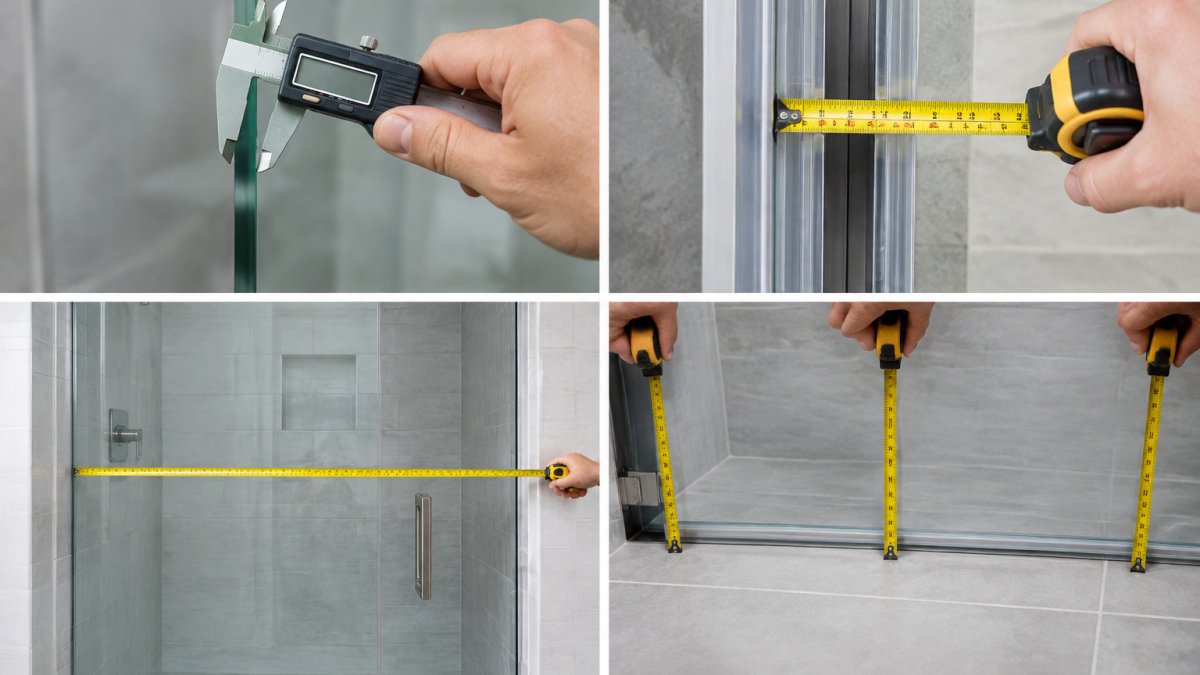
Most ordering mistakes come from measuring the wrong thing. The glass thickness, the seal channel width, the door length, and the floor gap are four separate numbers, and confusing them is how people end up with a sweep that will not seat or will not reach the tile.
1. Glass thickness. Measure across the edge of the glass, not across the face. Browse the L Strike with Soft Touch wall seal to see how a wall seal closes the vertical edge against the wall. Use calipers if you have them; a tape measure works if you sight straight down the edge.
2. Seal channel width. The channel is the slot in the sweep that the glass slides into. It is not the same as the glass thickness. Measure the old seal's channel across its opening, then compare that to the new seal's stated glass size, not to the glass itself.
3. Door length. Measure the full width of the door from edge to edge at the bottom. Do not measure the old sweep if it was trimmed short or has shrunk. Lily's Premium drip seals ship in 36-inch lengths and can be trimmed to fit, so a door up to 36 inches is covered by one piece.
4. Floor gap and clearance. Measure from the bottom of the glass to the tile or threshold at the left end, the middle, and the right end. Note the smallest and largest numbers.
Fit verification before checkout. Run this checklist against the numbers you wrote down:
- Glass thickness matches the sweep's stated glass size (1/4", 3/8", or 1/2").
- Channel width matches the glass, not the old seal's swollen opening.
- Stock length is at least as long as the door width, so you can trim rather than stretch.
- The flexible flap or fin is longer than the largest floor gap you measured.
- The sweep is intended for a moving door, not a fixed panel, if it will be mounted on a swinging or sliding door.
- Hinge clearance is clear: the sweep should not contact the hinge or the frame as the door swings.
Watch out: If the gap varies by more than 1/4" across the door, no standard sweep will seal it cleanly. Fix the threshold or floor slope first, or the new seal will leak in the same place as the old one.
Choosing a Frameless Door Bottom Seal by Door Style
Door style narrows the choice, but it is not the only variable. The gap size, where the water travels, and the threshold shape decide as much as the hinge or track does. Use the door style first, then confirm the choice against the gap and threshold.
Hinged doors. The door swings in an arc, so the sweep has to flex as it moves. A drip rail with a soft flap is the usual choice because the flap bends away from the tile instead of catching on it.
Sliding doors. The door runs on a track and closes with a lateral motion, so the sweep needs a low profile that will not catch on the track or the fixed panel.
Fixed glass panels. These do not move, so a stationary seal is enough. Do not put a moving-door sweep on a fixed panel; the flexible flap is unnecessary and can trap water against the tile.
Choosing by gap size. If the floor gap is 3/8" or less and fairly even, a single-fin or twin-fin sweep will usually close it.
Choosing by water direction. Water that pools at the bottom of the door and runs outward needs a drip rail that deflects it back into the pan.
Choosing by threshold configuration. A flat tile threshold takes a standard drip rail. A raised curb or a threshold with a lip may need a sweep with a shorter flap so the door does not rub.
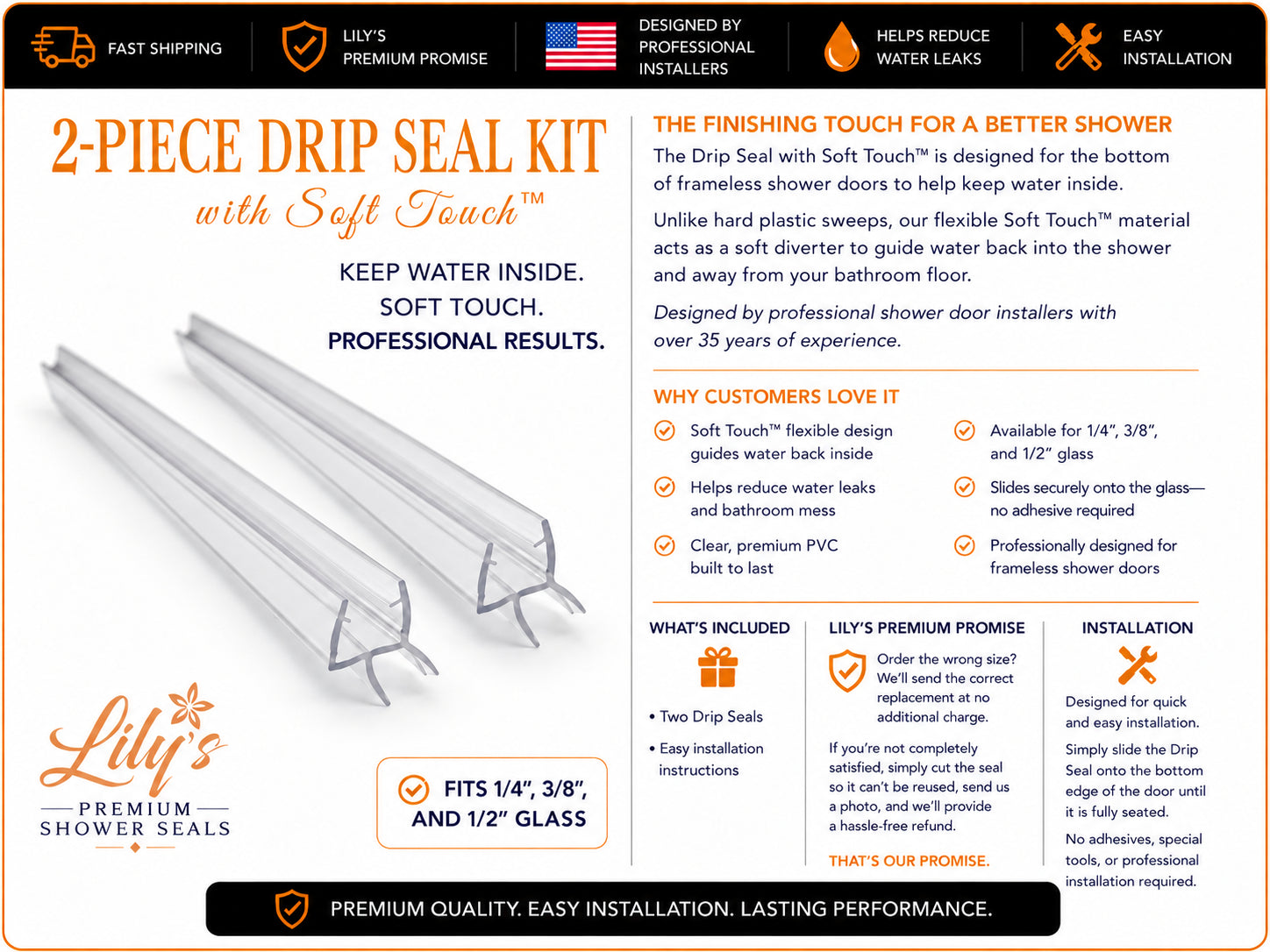
Decision sequence. Start with the door type, then check the gap size, then check the threshold, then confirm hinge or track clearance. The 2-Piece Drip Seal Kit with Soft Touch™ includes two 36-inch seals sized for your glass thickness, which covers two sides of a typical enclosure when both the moving door and the fixed panel need a new seal.
Watch out: A sweep that fits the door style but not the gap will leak at the floor, and a sweep that fits the gap but not the door swing will catch or drag. Confirm both before you trim anything.
Shower Door Sweep with Drip Rail: Pros, Cons and Best Uses
Drip rail sweeps are a common choice for frameless doors, and they have clear strengths and limits.
Pros:
- Directs water back into the shower
- Crystal clear PVC construction
- Quiet closing when the flap is soft and flexible
Cons:
- The rail must sit square against the glass, so installation takes more care
- Hard rails can scratch tile if they are not trimmed properly
- Not every drip rail suits every glass thickness
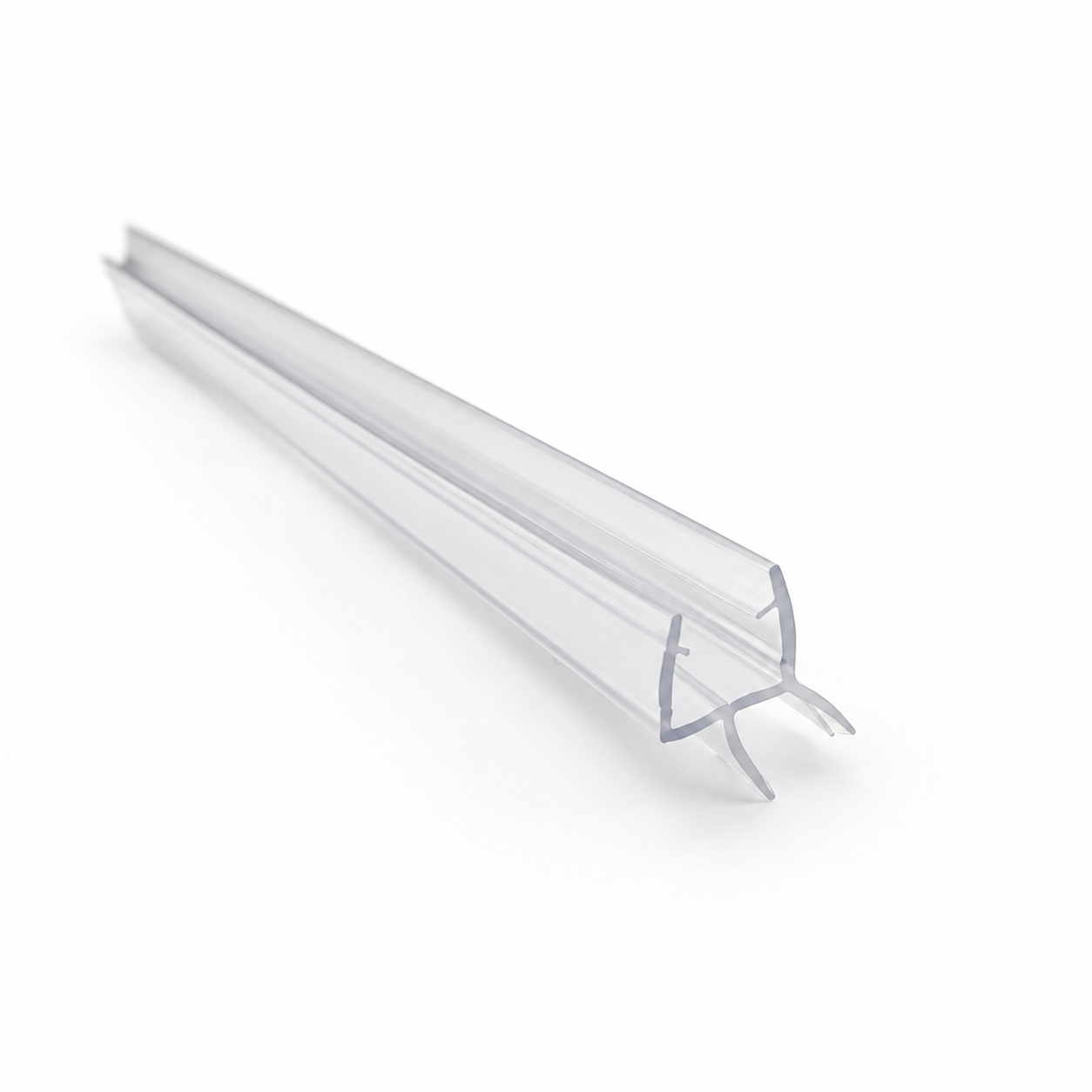
Best uses: Drip rail sweeps suit showers with visible water on the floor outside the door, and they work well on hinged doors. The Drip Seal with Soft Touch™ is a crystal-clear PVC option that fits 1/4", 3/8", and 1/2" glass and slides onto the glass without adhesive.
How to Replace a Shower Sweep with Drip Rail Step by Step
What you will need: A utility knife, a tape measure, a clean cloth, isopropyl alcohol, and your new seal.
Step 1: Remove the old seal. Peel or slide the old sweep off the glass. Work slowly so you do not chip the glass edge. Expected result: the glass edge is bare and clean.
Step 2: Clean the glass edge. Wipe the edge with isopropyl alcohol and let it dry completely. Expected result: no soap film or residue remains.
Step 3: Measure and trim the new seal. Lay the new drip seal against the door bottom and trim it to length with a sharp knife. Expected result: the seal reaches the full width with no overhang.
Step 4: Slide the seal onto the glass. Press the seal onto the glass edge until it sits flush. No adhesive is needed. Expected result: the flexible flap hangs over the tile.
Step 5: Test the seal. Close the door several times and check that the flap bends without catching. Expected result: smooth, quiet closure with no gap at the floor.
Watch out: If the seal does not sit flush, check that the glass thickness matches the seal you ordered before you force it.
The steps below cover the replacement process from removing the old seal to testing the new one.
| Step | What to do | Time or frequency |
|---|---|---|
| 1. Remove the old seal | Peel or slide it off slowly to avoid chipping glass | Not specified |
| 2. Clean the glass edge | Wipe with isopropyl alcohol and let dry | Until dry |
| 3. Measure and trim | Lay seal against door bottom and trim to length | Not specified |
| 4. Slide seal onto glass | Press until flush; no adhesive needed | Not specified |
| 5. Test the seal | Close door several times, check for catching | Several closures |
Ordering Your Replacement Seal from Lily's Premium Shower Seals
Once you know your glass thickness and length, you can order with confidence. Lily's Premium Shower Seals offers several options depending on which seals you need.
- Drip Seal with Soft Touch™: A single 36-inch crystal-clear drip seal at $19.94.
- 2-Piece Drip Seal Kit with Soft Touch™: Two 36-inch seals at $32.99, useful for covering two sides.
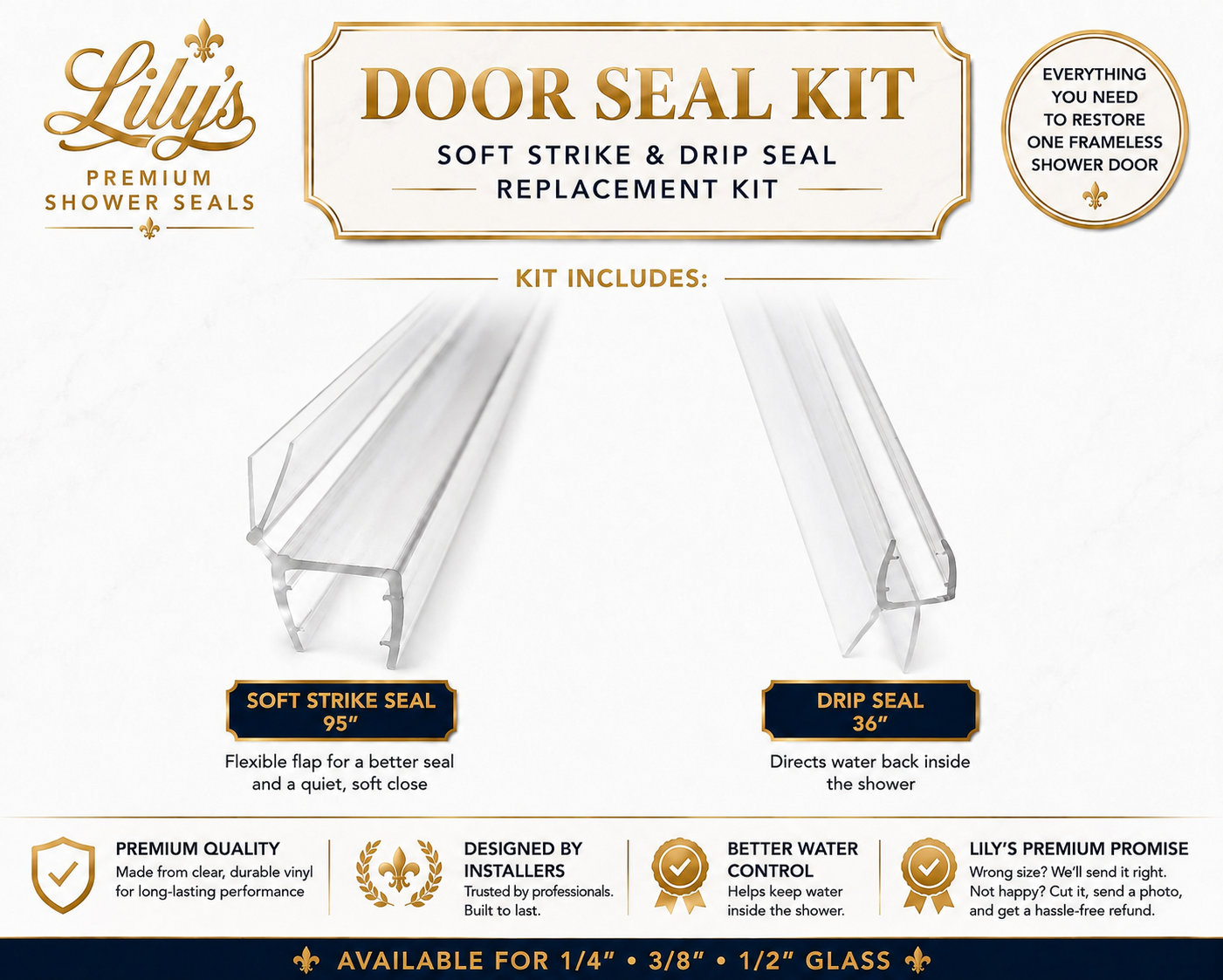
- Door Seal Kit (Soft Strike and Drip Seal): A two-piece replacement kit at $49.95 for the seals that wear out most often.
- Complete Refresh Kit: A hinge, soft strike, and drip seal set at $69.95 for a full restoration.
Free shipping is available to the 48 contiguous states. If you order the wrong size, we will send the correct replacement at no charge. If you are not satisfied, cut the seal so it cannot be reused, send us a photo, and we will provide a refund. For installation questions during the job, our installation and support center walks you through replacement and troubleshooting.
Frequently Asked Questions
How do I know which door sweep fits my frameless shower door?
Start by measuring your glass thickness: most frameless shower doors use 1/4-inch, 3/8-inch or 1/2-inch glass, and each Lily's Premium drip seal and soft strike seal is made for those sizes, so select your thickness before checkout. Then measure the bottom gap and the length of the existing seal. Our seals are 36 inches for drip seals and 86 or 95 inches for hinge and soft strike seals, and all can be trimmed to fit. If you ordered the wrong size, Lily's will send the correct replacement at no charge.
What bottom gap should a frameless shower door have?
The gap between the bottom of the glass and the threshold or floor should be small enough that the sweep or drip seal makes firm contact when the door closes, without binding or dragging. Measure at both ends of the door, since floors are often not level. A consistent gap across the width of the door lets the seal deflect water back into the shower. If the gap is uneven, adjust the door hardware before replacing the seal, because a new sweep will not fix a misaligned door.
Can I replace a shower sweep with drip rail myself?
Yes. Replacing a bottom sweep with drip rail is a DIY task you can complete yourself. Remove the old seal, clean the glass edge, measure the new seal to the door width, trim it to length with a sharp utility knife, and slide it onto the glass. Lily's Premium drip seals slide on without adhesive. Trim carefully and test the door's closing action before using the shower.
