
Quiet Closing Frameless Shower Door Seals: 2026 Guide
Table of Contents
- Why Frameless Shower Door Seals Fail (And What It Costs You)
- Types of Frameless Shower Door Seals: Choosing the Right Seal Profile
- Measuring Glass Thickness for Shower Seals: Get It Right the First Time
- The Quiet Close Difference: How Soft Touch™ Technology Works
- Frameless Shower Door Seal Replacement Guide: Step-by-Step Installation
- How to Keep Water Inside a Curbless Shower with the Right Seal
- Which Lily's Premium Shower Seal Is Right for Your Door?
- Frequently Asked Questions
Last Updated: September 1, 2026
Why Frameless Shower Door Seals Fail (And What It Costs You)
Frameless shower door seals degrade due to repeated mechanical stress from door closure, chemical exposure from cleaning products, and natural aging of low-grade vinyl or silicone materials. Persistent water leakage damages subflooring, promotes mold growth, and creates slip hazards. According to the Environmental Protection Agency's WaterSense program, water damage from household leaks accounts for significant structural repair costs annually, with shower enclosure failures a common source. A properly functioning frameless shower door seal closes quietly with soft compression that confirms a tight fit without impact noise.

This guide covers every seal type, how to measure for the right fit, and how to replace a worn seal yourself.
Types of Frameless Shower Door Seals: Choosing the Right Seal Profile
The seal profile determines how the door closes, where water is blocked, and whether installation requires adhesive. Getting the profile wrong is the most common DIYer mistake when ordering replacement seals online.
Frameless shower door seals fall into two primary categories: glass-to-glass and glass-to-wall. A soft-fin profile compresses against the opposing surface rather than making rigid contact, producing a quieter close and more reliable watertight barrier.
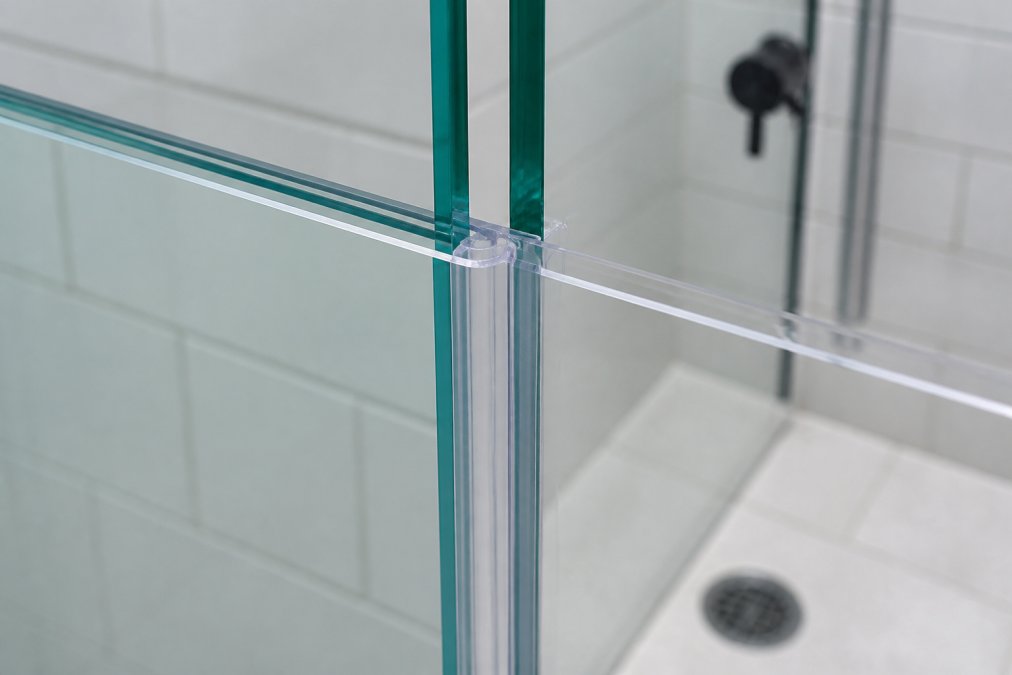
| Seal Type | Closes Against | Mounting Method | Best For |
|---|---|---|---|
| Soft Strike | Fixed glass panel | Friction fit, no adhesive | Glass-to-glass frameless doors |
| L Strike | Wall or tile surface | Pre-applied high-bond tape | Glass-to-wall frameless doors |
| Bottom Sweep / Drip Rail | Threshold or floor | Friction fit or adhesive | Water containment at door base |
| Jamb Seal | Door frame or hinge side | Adhesive or friction | Side gap sealing |
Soft Strike Seals: Glass-to-Glass Closure
The Soft Strike seal is designed for frameless shower enclosures where the door closes against a fixed glass panel. The seal slides onto the glass edge of the door itself with no adhesive required. A dual-fin or h-wipe profile creates two compression points, improving both the watertight barrier and acoustic dampening. When the fin compresses properly, you hear nothing, that's the functional test for correct installation.

L Strike Seals: Glass-to-Wall Closure
The L Strike seal handles glass-to-wall closure geometry. Because it mounts to the wall rather than the glass edge, the L Strike fits all frameless shower door glass thicknesses without adjustment. The L-shaped profile creates a two-plane seal: one face presses against the door glass edge, and the other anchors flat to the wall.
Vinyl vs. Silicone: Material Differences That Matter Long-Term
Vinyl (PVC): Premium clear PVC maintains flexibility and transparency over time. Lower-grade vinyl yellows, becomes brittle, and loses compression within one to two years. Crystal clear PVC formulations resist discoloration and hold durometer longer. Vinyl seals are easier to cut with ordinary scissors.
Silicone: Silicone is naturally mold-resistant and handles temperature extremes well. Its weakness is adhesion, silicone strips relying on adhesive tape can delaminate in high-humidity environments. Silicone also requires more precise alignment than vinyl.
According to the American Chemistry Council's vinyl sustainability report, properly formulated PVC compounds maintain structural performance for many years in high-humidity applications. For shower door seals, clear PVC with appropriate plasticizer content outperforms basic silicone strips in long-term compression retention.
Measuring Glass Thickness for Shower Seals: Get It Right the First Time
Measuring glass thickness is the step most DIYers skip, and it's why many online seal orders get returned. A Soft Strike seal ordered for 3/8" glass will not seat correctly on 1/2" glass.

Frameless shower doors are manufactured in three standard thicknesses: 1/4" (6mm), 3/8" (10mm), and 1/2" (12mm). To identify your glass thickness accurately:
- Use a digital caliper for the most accurate reading, placing the jaws flat against both faces of the glass at the door edge.
- If you don't have a caliper, use a tape measure to measure the glass edge directly.
- Cross-reference with the door hardware, which is specified for a particular glass thickness.
- When in doubt, measure twice. A 1/4" difference in glass thickness is the difference between a seal that grips and one that falls off.
The L Strike seal is thickness-independent because it mounts to the wall, not the glass edge. If you're replacing a glass-to-wall seal and want to avoid the measurement step, the L Strike is the more forgiving choice.
The Quiet Close Difference: How Soft Touch™ Technology Works
Traditional frameless shower door seals are rigid by design, creating a defined stop point for the door, but that stop is an impact. Over time, repeated impact accelerates wear on both the seal and the glass edge.
Soft Touch™ technology addresses this at the material level. The sealing edge is formulated from a flexible compound that compresses on contact rather than stopping abruptly. The door decelerates through the last few millimeters of travel as the fin compresses, absorbing kinetic energy that would otherwise produce impact noise. A fin that compresses evenly across its full length creates a continuous seal, while a fin that bottoms out at one point creates a gap.
Frameless Shower Door Seal Replacement Guide: Step-by-Step Installation
Replacing a frameless shower door seal is a genuine DIY task most homeowners complete in under 30 minutes with no special tools. Before starting, remove the old seal completely and clean the glass edge or wall surface with isopropyl alcohol.
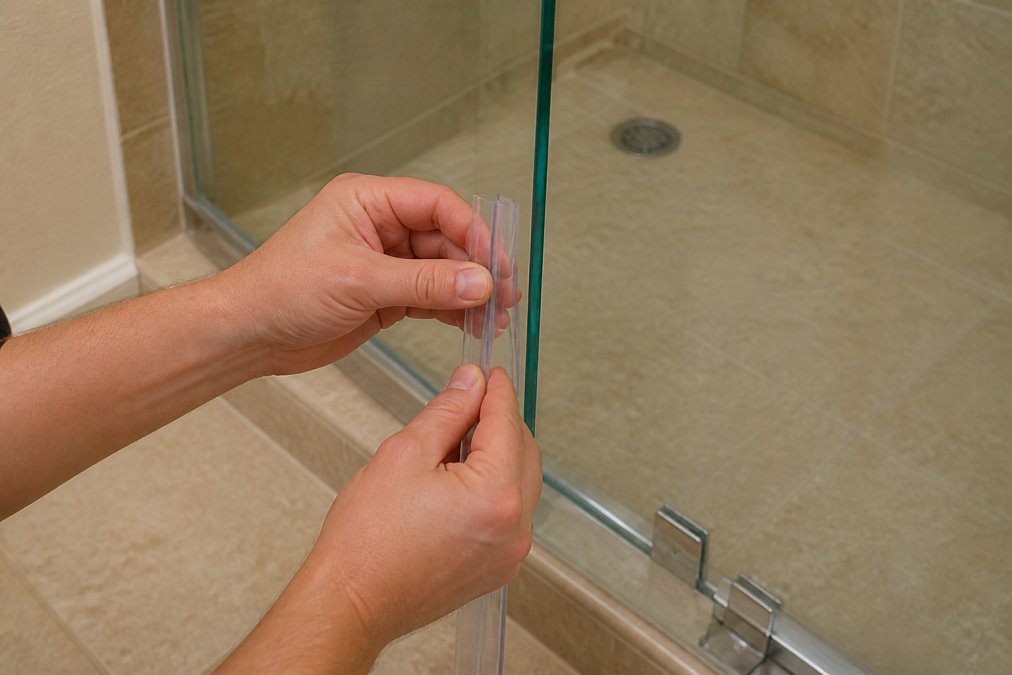
Installing a Soft Strike Seal (No Adhesive Required)
The Soft Strike Seal slides onto the door's glass edge as a friction fit.
- Measure and cut to length. Lay the seal alongside the door edge and mark your cut point with a felt-tip pen. Use scissors or a utility knife to cut cleanly at 90 degrees.
- Clean the glass edge. Wipe the door edge with isopropyl alcohol and allow it to dry fully.
- Start at the top. Align the seal channel with the glass edge at the top of the door. Press the channel onto the glass firmly, working downward in 6-8" increments.
- Seat the seal fully. Run your thumb along the full length of the installed seal to confirm the channel is fully seated.
- Test the closure. Close the door slowly and observe the soft-fin contact against the fixed glass panel. The fin should compress evenly across its full height with no gaps.
Expected result: The door closes quietly with a soft compression feel.
Installing an L Strike Seal on a Wall or Tile Surface
The L Strike Seal uses pre-applied high-bond adhesive tape. Surface preparation is critical.
- Determine placement. Hold the L Strike against the wall with the door closed to mark where the door glass edge contacts the seal face.
- Clean the wall surface. Wipe the tile or wall surface with isopropyl alcohol and allow it to dry for at least 5 minutes.
- Remove the adhesive backing. Peel the backing from the pre-applied high-bond tape in one continuous motion.
- Press and hold. Align the seal with your reference marks and press firmly against the wall for 30 seconds along the full length.
- Allow cure time. Wait at least 1 hour before using the shower. Full adhesive bond strength develops over 24 hours.
How to Keep Water Inside a Curbless Shower with the Right Seal
Keeping water inside a curbless shower is fundamentally different from containing water in a standard curbed enclosure. Without a threshold to act as a physical barrier, the shower door seal carries the full burden of water containment at the door edge.
According to the Tile Council of North America's installation handbook, curbless shower designs require particular attention to door seal selection and floor slope to prevent water migration. For curbless installations, the seal profile matters more than in standard enclosures. A deep-fin soft-fin seal creates a longer compression zone, maintaining contact even when water pressure from a high-flow showerhead pushes against the door.
Practical steps for maximizing water containment in a curbless shower:
- Confirm the seal compresses fully. Close the door and observe the fin from outside. It should be visibly compressed, not just touching.
- Check for installation gaps. Run a flashlight along the seal from inside the shower with the door closed. Any light visible from outside indicates a gap.
- Inspect the bottom sweep. The door sweep at the floor is the second most common water escape point.
- Verify door alignment. A door that doesn't hang plumb will create uneven compression across the seal height.
Which Lily's Premium Shower Seal Is Right for Your Door?
The right seal depends on where your door closes and how many doors you're replacing.
For a single door closing against a fixed glass panel: The Soft Strike with Soft Touch™ at $29.95 is the correct choice. It slides onto the glass edge without adhesive, fits 1/4", 3/8", and 1/2" glass, and comes in 86" or 95" lengths that can be trimmed to fit.
For a single door closing against a wall or tile: The L Strike with Soft Touch™ at $34.95 is the right profile. It mounts to the wall with pre-applied high-bond adhesive tape and fits all glass thicknesses.
For contractors, property managers, or homeowners with multiple doors: The 5-Piece Soft Strike Seal Kit at $119.95 and the 5-Piece L Strike Seal Kit at $139.95 offer the same Soft Touch™ performance at better per-unit value.
| Product | Price | Closes Against | Glass Thickness | Mounting |
|---|---|---|---|---|
| Soft Strike with Soft Touch™ | $29.95 | Fixed glass panel | 1/4", 3/8", 1/2" | Friction fit, no adhesive |
| L Strike with Soft Touch™ | $34.95 | Wall or tile | All thicknesses | Pre-applied high-bond tape |
| 5-Piece Soft Strike Kit | $119.95 | Fixed glass panel | 1/4", 3/8", 1/2" | Friction fit, no adhesive |
| 5-Piece L Strike Kit | $139.95 | Wall or tile | All thicknesses | Pre-applied high-bond tape |
If you order the wrong size, Lily's Premium Shower Seals offers a hassle-free replacement. For Soft Strike seals, wrong-size orders are the most common issue new customers encounter, and the hassle-free replacement policy exists because measuring glass thickness is genuinely confusing the first time.
The Soft Touch™ fin is why these seals cost more than generic options. That cost difference buys a specific functional outcome: a quiet close, a continuous watertight barrier, and a seal that doesn't yellow or crack within a year.
Shower door leaks and impact noise are fixable problems with the right seal profile and materials. Generic seals from hardware suppliers often use hard plastic strike designs that produce impact noise, degrade quickly, and fail within a year. Lily's Premium Shower Seals engineers the Soft Touch™ sealing edge specifically to eliminate that failure pattern: the flexible fin compresses on contact, creates a continuous watertight barrier, and lasts through years of daily use without yellowing or cracking. Shop all shower seals at Lily's Premium Shower Seals and get the right profile for your door the first time.
Frequently Asked Questions
Q: What is the best seal for a frameless shower door?
A: The best seal depends on how your door closes. If it closes against another glass panel, a Soft Strike seal with a friction-fit design is the right choice. If it closes against a wall or tile, an L Strike seal with pre-applied adhesive tape works best. Lily's Premium Shower Seals offers both types in 1/4", 3/8", and 1/2" glass thicknesses, all featuring Soft Touch™ technology for a quieter, tighter close than standard hard plastic seals.
Q: Can I make my shower door soft close?
A: Yes. Replacing a hard plastic strike seal with a flexible soft-fin seal is the most direct way to eliminate the harsh impact noise when a frameless shower door closes. Lily's Soft Touch™ sealing edge absorbs the closing force instead of creating a rigid plastic-on-glass contact point. No special hardware or hinges are needed, the seal itself is what changes the closing feel and sound.
Q: How do I choose the right thickness for a shower door seal?
A: Measure your glass with a digital caliper or a credit-card thickness gauge at the edge of the panel. Standard frameless shower glass comes in three common thicknesses: 1/4" (6mm), 3/8" (10mm), and 1/2" (12mm). Match that measurement to the seal size before ordering. Lily's Premium Shower Seals offers all three sizes, and if you order the wrong one, the brand offers a hassle-free replacement.
Q: Why is my frameless shower door not closing properly?
A: A worn or compressed seal is the most common cause. Over time, vinyl and soft-fin seals flatten, crack, or discolor, losing their ability to create a watertight barrier and a smooth door closure. A misaligned door strike or an installation gap that has widened can also cause the door to feel loose or fail to latch. Replacing the seal usually resolves both the closure problem and any associated water leakage.
Q: How long do frameless shower door seals typically last?
A: Hard plastic seals often show visible wear, cracking, yellowing, or compression, within two to four years in daily-use showers. Premium clear vinyl seals with mold-resistant formulations tend to hold up longer, though exact lifespan depends on water quality, cleaning products used, and how often the door is operated. Inspect your seal annually for discoloration, brittleness, or gaps at the glass edge, and replace it before water leakage begins.